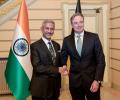
The era where nations thrived through rigid alignments is giving way to an age where the connective State defines power. For India, that era has arrived, points out Dr Nishakant Ojha.
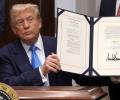
For India, the challenge is to strike a balance between tactical necessity and economic priorities, point out Pravin Krishna and Monil Sharma.

Japan is expected to increase its investment target in India from the earlier 5 trillion yen ($34 billion) to almost 10 trillion yen.
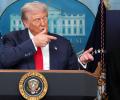
In trade negotiations, as in chess, sometimes you need to accept a temporary disadvantage to secure a better long-term position, points out Sonal Varma, chief economist (India and Asia ex-Japan) at Nomura.
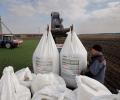
'China reduced its exports of urea to India gradually.' 'In 2020-2021 we imported 28 lakh tonnes of urea which reduced to 16 lakh tonnes in 2022-2023 and that has now reduced to 1 lakh tonnes in 2024-2025.'

Amid uncertainty over trade talks with the US, Prime Minister Modi asserts India's commitment to protecting the interests of farmers and fishermen, vowing no compromise on their behalf.

'This is not just about Modi saying it, every Indian should say this -- if we want India to become the third-largest economy, every political party and every leader, keeping aside their hesitations, must work in the nation's interest and awaken the spirit of Swadeshi among the people'
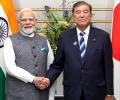
Prime Minister Shigeru Ishiba's sudden resignation after only a year in office has thrown Japan into political turmoil, raising doubts about how the country will handle economic and regional challenges, observes Dr Rajaram Panda.
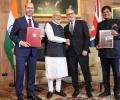
India and the UK on Thursday inked a landmark free trade agreement (FTA) that will cut tariffs on British whisky, cars and an array of items, besides boosting bilateral trade by around $34 billion annually.
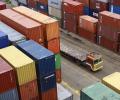
The US Trade Representative noted that India's average applied tariff rate stood at 17% per cent, the highest of any major world economy.
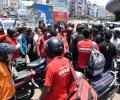
However, under several external factors -- such as technological disruption or advancement, regulatory or policy changes, or economic shocks -- the gig workforce may grow only to 32.5 million by 2047, a report points out.
'That way you're not hostage just to US sort of exports to India.'

India's mango exports to the US are registering healthy growth, and irradiation operations at a key mango treatment facility in Mumbai have been normalised after a brief disruption due to a data recording error earlier this month, an official said on Tuesday. The Mumbai-based irradiation facility, which handles the highest volume of mangoes destined for the US, faced an issue during the irradiation process conducted on May 8 and 9, 2025.
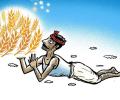
India's policy for agriculture trade must move commodity-by-commodity to gain maximum benefits as US President Donald Trump's 26 per cent tariff on exports from the country take effect, said agriculture economist Ashok Gulati in a recent policy paper.
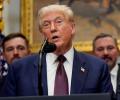
"India is not only buying massive amounts of Russian Oil, they are then, for much of the Oil purchased, selling it on the Open Market for big profits," Trump said in a social media post on Monday.
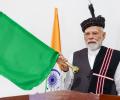
In the last 11 years, India and the world witnessed what he stood for, what he promised and did not deliver, and what he actually stood for and practised without fearing how history would judge him. Modi's tenure has been punctuated with headline-grabbing decisions, symbolic gestures, and stage-managed moments that continue to define his leadership and India's politics, points out Ramesh Menon.

Corporate bond issuances fell by around 22 per cent in August, despite easing yields as issuers delayed raising funds awaiting the US Federal Reserve to start cutting interest rates from this month. Corporates and financial institutions expect yields to fall further and borrowing costs to become cheaper, said market participants. The US Fed is widely expected to cut interest rates by 25 bps in the 17-18 September meeting, marking the start of a downward interest rate cycle.
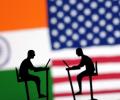
India and the US have finalised the terms of reference outlining the roadmap for negotiations of the proposed Bilateral Trade Agreement (BTA), according to a statement issued by the US. US Trade Representative (USTR) Jamieson Greer said that these ongoing talks will help achieve balance and reciprocity by opening new markets for American goods and addressing unfair practices that harm US workers.

Punjab Police thwarted farmers' attempt to go to Chandigarh on the Samyukta Kisan Morcha's call for a week-long dharna beginning Wednesday, as multiple checkpoints were set up across the state and security stepped up at all entry points of the Union Territory.
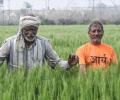
'Rainfall does not appear to have a statistically significant impact on foodgrain production since the last few years, which contrasts with the traditional view of India's heavy reliance on monsoon rains for agriculture.'
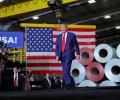
India maintains "high" import duties on a wide range of American goods such as agricultural items, drug formulations, and alcoholic beverages, besides imposing non-tariif barriers, a US report has said. A day before announcing reciprocal tariffs, the US Trade Representative (USTR) released the 2025 National Trade Estimate (NTE) Report on March 31.

A new study by IIT-Kharagpur warns that ozone pollution could significantly reduce agricultural yields in India, particularly impacting wheat, rice, and maize production. The study, published in the journal 'Environmental Research', highlights the vulnerability of major food crops to rising surface ozone levels, especially in the Indo-Gangetic Plain and Central India. The researchers call for effective emission reduction strategies to mitigate these risks and ensure global food security.
Zende along with a group of traders met joint commissioner of Police Ranjan Kumar Sharma and apprised him about the calls.
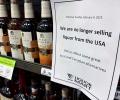
'We have to be prepared for the larger disruption that is likely to take place.'

The rate of unemployment in the country, measured in monthly term, rose to 5.6 per cent in May from 5.1 per cent in April this year mainly due to seasonal variation, showed the government data released on Monday.
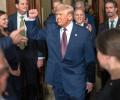
The White House has said India imposes a 100% tariff on American agricultural products and the high levies charged by other countries make it "virtually impossible" for US products to be exported to those nations. President Donald Trump has repeatedly criticised the high tariffs charged by India and other countries on American goods. He plans to roll out a set of reciprocal tariffs on April 2, which he says will be "Liberation Day" for the US.

'The quality of justice is directly linked to the quality of judges -- if that suffers, justice delivery suffers.'
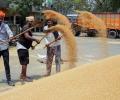
ISRO has projected wheat production of 122.24 million tonnes.
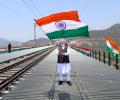
There are challenges galore before him, and it is not going to be easy. In the next four years, he has to conjure a system that changes the optics about him and the BJP both nationally and internationally so that he can ride back on his own, claim the top slot, and not have to lean on a coalition, asserts Ramesh Menon as Modi 3.0 completes a year in power.
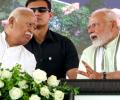
BJP and RSS leaders are once again pushing to remove the words 'secular' and 'socialist' from the Constitution's Preamble, showing a deeper effort to change India's identity from a diverse, multi-religious republic to a Hindu-first nation, even though they don't have the numbers in Parliament to officially change the Constitution, observes N Sathiya Moorthy.
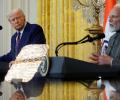
'But I don't think the government is in a great hurry to sign the BTA.'

An inconclusive end to this war will pose high risk for Netanyahu of a cascading demand for a regime change in Israel, predicts Ambassador M K Bhadrakumar.
A team of senior officials from India will again visit Washington this month to hold discussions with their US counterparts on the proposed bilateral trade agreement (BTA), government sources said on Thursday. To give impetus to the talks, India's chief negotiator Rajesh Agrawal, special secretary in the Department of Commerce, and Assistant US Trade Representative for South and Central Asia Brendan Lynch had last month held three-day talks in Washington.
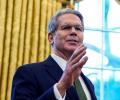
As in-person negotiations between India and the US kickstarted on Wednesday, Treasury Secretary Scott Bessent said he expected India to strike the first bilateral trade deal to avert President Donald Trump's reciprocal tariffs.
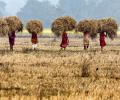
In a significant policy shift aimed at boosting agri-productivity and rural prosperity, Finance Minister Nirmala Sitharaman on Saturday announced six new agricultural schemes while increasing the subsidised Kisan Credit Card loan limit to Rs 5 lakh from the existing Rs 3 lakh, benefiting 7.7 crore farmers, fishermen, and dairy farmers.
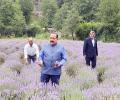
From using lavender in traditional Dogri embroidery to making essential oils, beauty products and food syrups infused with this flowering plant, Bhaderwah, once known for its maize fields, is embracing lavender to bring about an economic transformation to their small town.

Ahead of their planned protest in Chandigarh on March 5, several Samyukta Kisan Morcha (SKM) leaders were detained in early morning raids at their residences on Tuesday and Chief Minister Bhagwant Mann denounced the agitating farmer unions, saying they have turned Punjab into a 'state of dharnas' and caused huge losses to it.

At the PMO, policies are framed by factoring in analytical perspectives, implications, sustainability, and other dimensions.
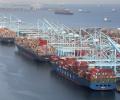
India and the US have decided to hold sector-specific talks in the coming weeks to finalise the structure of the proposed bilateral trade agreement (BTA), the government said on Saturday. The engagement between the two countries came in the backdrop of the USA's threat to impose reciprocal tariffs on its key trading partners, including India, on April 2.

The International Monetary Fund (IMF) has slapped 11 new conditions on Pakistan for the release of the next tranche of its bailout programme and warned that tensions with India could heighten risks to the scheme's fiscal, external, and reform goals, according to a media report on Sunday.
 © 2026 Rediff.com - Advertise with us - Disclaimer - Privacy Policy - Sitemap - Feedback - About us - Terms of use - Grievances